


As pointed out by Piketty, when the rate of return on capital ® is higher than the rate of economic growth (g), inequality rises. The share of wealth is skewed toward the top 10 percentile link | link

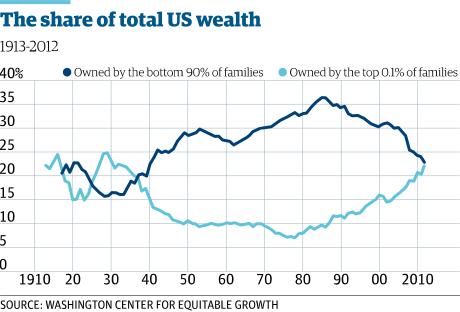
The total wealth of the bottom and second 20 percentiles is stagnant link. Stock ownership, which represents control over companies, is also significantly skewed toward the top 10 percentile. Recent data indicate that 87% of stocks and 84% of private businesses are owned by the top 10%. The top 10% also hold 80% to 90% of stocks, bonds, trust funds, and business equity, as well as over 75% of non-home real estate. Since financial wealth determines control over income-producing assets, we can say that just 10% of the people effectively own the United States of America. Recent data indicate that the top 10% of U.S. households own about 90–93% of all stock market wealth.

This shows that the top 10% is the group that controls the U.S. economy. link | link
These values are shocking, but the white knights of capitalism still argue that despite this trend, the quality of life of the bottom has continued to increase over time. Even more so since the Reagan, Thatcher, and Yeltsin era, they have come to believe that transferring wealth to the rich will eventually trickle down. Therefore, a more egalitarian distribution of wealth would not only be ineffective but harmful.
In opposition, I will present arguments in support of egalitarian policies.
The main problems of inequality are associated with the following key features:
Concentration of power: Big corporations have immense bargaining power, creating monopolies and limiting competition through barriers to entry.
Influence in politics: Government is constantly lobbied and corrupted by the interests of companies. Workers have no capital or resources to defend their position efficiently.
Lack of demand for products: Keynes argued that an efficient economy requires healthy aggregate demand, where workers’ purchasing power is limited only by supply. However, in the modern economy, workers’ purchasing power is limited by the amount of money they have.
Distortion of demand toward luxury items: When a person buys a yacht or builds a mansion, resources that could benefit the lower class disproportionately benefit the upper class instead.
Productive dualism: Development economists such as W. Arthur Lewis noted that poor countries contain a small modern, high-productivity sector alongside a much larger traditional, low-productivity sector. This dualism was once seen as specific to developing nations, unlike advanced economies, where technology and productivity were assumed to be broadly shared.
There is enough empirical evidence showing that inequality stagnates the economy and stifles progress.
High inequality is associated with higher rates of teen pregnancy, mental illness, drug use, and obesity. It is also linked to lower life expectancy. This is mainly caused by social insecurity in countries with high inequality.
Inequality is positively correlated with crime rates and poor educational performance, showing that inequality causes a lack of opportunities and stifles social mobility, leading people to spend their time on crime.
Some multi-country studies suggest that economic growth and industrialization are negatively correlated with income inequality, meaning that income inequality causes slower growth of the economy.
Conversely, trade openness is generally associated with a decrease in inequality, showing that inequality is a barrier to international trade.
There is a significant positive association between the unemployment rate and the Gini coefficient, meaning higher income inequality leads to higher unemployment. Research suggests that a 3 percentage point increase in the Gini coefficient is associated with an increase in the unemployment rate of approximately 10 percentage points. link
Nobel laureate Joseph Stiglitz argues that the concentration of wealth at the top leads to lower economic growth and decreased efficiency because it fails to fully utilize the potential of all members of society. In his analysis, widespread inequality makes economies neither stable nor sustainable in the long run.
Inequality and greenhouse gas (GHG) emissions are positively associated. Research indicates that the wealthiest 10% of people were responsible for approximately half of global emissions in 2015, while the top 1% alone were responsible for 15%, showing that those capable of mitigating the consequences transfer the costs onto the poor. link
In highly unequal societies, markets respond to “dollars rather than people,” leading to resource misallocation. For example, in 2000, pharmaceutical firms developed no new drugs for TB (which kills 2 million poor people annually) but developed multiple drugs for vanity issues like balding. Society’s resources go into fancy cars, beauty products, and yachts, rather than affordable food or housing, simply because some have millions of dollars’ worth of “votes” and some have very few.
Research by Wilkinson and Pickett (2009, 2010) demonstrates that more equal societies perform better across almost all social indicators. Highly unequal societies suffer from significantly higher rates of mental illness, homicide, obesity, and imprisonment, showing that living in a society marked by disparity causes global social unrest. link
There is a direct empirical link between inequality and lower life expectancy. While rich countries have life expectancies exceeding eighty, poor countries-or poor populations within rich ones-often fall under fifty-five. link
Some research suggests a trade-off. An analysis of industrial countries found that redistributive state policies designed to further equality are sometimes at odds with economic efficiency. One index of 100 countries observed that those with higher political freedom (often associated with equality-seeking policies) actually experienced slower growth.
So we need a solution that does not include wealth redistribution. The most optimal option is an expansion of the cooperative sector.
Empirical plots and regressions show a significant negative relationship between the size of a country’s cooperative sector and its level of income inequality. This suggests that an expanded cooperative economy plays an “inequality-attenuating role” in society. Regions with robust cooperative sectors have been linked to better income equality and improved regional economic resilience. For example, research indicates that a one percentage point increase in cooperative turnover as a percentage of GDP is correlated with a 0.78 percentage point decrease in the Gini coefficient. link
In conclusion, inequality is a significant threat to the modern world, and it should be mitigated. However, we should stay careful about the way we eliminate inequality without making things worse, and cooperatives with self-management are a way to address these concerns.