

2·
10 hours agoAnyone who fails to get references & leaps to hasty judgements. Same reason as above.
Anyone who fails to get references & leaps to hasty judgements. Same reason as above.
Anyone who calls their irrationality challenged “engagementbait” or “ragebait” when they can’t refute it because the challenge is absolutely correct.

Anyone who says
For me it’s saying, “we can’t joke about anything anymore”.
Sirens go off immediately 🚨
So the authors of these books?
Or of various feminist book titles featuring the noun?
Or the vast amount of people who use the noun self-referentially in dating communities (eg, “F4F/M”), classifieds (eg, “need a roommate […] females only”), or natural communication? In conventional language, it’s an acceptable word.
Maybe you have this wrong, and instead it’s those who in effect (which may defy intent) stigmatize an entire gender by claiming their noun is wrong instead of embracing it as a word of pride.
Imagine online activists started condemning usage of the word dutch as a slur. It’s bizarre: there is nothing wrong with the dutch, yet they’re acting as though we should think so & resist that urge? Why are they propagating problematic presuppositions we don’t have about the dutch? Why are they trying to make this official? Are they some special breed of stupid?
Continuing this analogy, they drag you into fights by claiming you’re a racist for using the word when you’re not actually saying anything offensive about the dutch. You & the rest of society know the word dutch isn’t offensive, yet these activists insist it is by pointing to some fringe online community spewing vitriolic propaganda about dutch inferiority specifically using the word dutch. You repudiate their claim by asking why some fringe group irrelevant to wider society gets to decide the meaning of words, but they condemn your “hurtful” language and say you’re as bad as them or one of them. Don’t be an asshole & use another word like Dutchperson, Netherlander, or Hollander they say: it’s the right thing to do & shows socially conscientious, moral rectitude.

I’m not sure this is only about regional variations (I wrote about before) where in North America liberal refers to modern liberalism whereas for the rest of the world it typically refers to classical liberalism. Regardless of their thoughts on classical liberalism, there’s still the concept that “protecting and enhancing the freedom of the individual” ought “to be the central problem of politics” or rank high up there, and that concept has a name: liberalism. Acting like there’s some fault in insisting freedom of the individual matters or that it has do with anything else is a shitty take on their part.
To address your other points, neither capitalism nor liberalism is essential to each other, and capitalism is older than liberal democracy.
Capitalism emerged in Britain, the Netherlands, and most of today’s high-income countries long before democracy.
Even in the recent past, capitalism has coexisted with undemocratic rule, as in Chile from 1973 to 1990, Brazil from 1964 to 1985, and Japan until 1945. Contemporary China has a variant of capitalism with a high level of state intervention, but its system of government is not a democracy by our definition. In many countries today, however, capitalism and democracy coexist, each system influencing how the other works.
Moreover, modern liberalism advocates market regulation.
Liberal democratic governments may play a major role directing economic development even with less left-leaning liberals.
These differences even among democracies are part of the explanation for governments’ differing roles in the capitalist economy. The Japanese and South Korean governments play a central role in setting the direction of the economy. But the amount of tax collected (both locally and nationally) is low compared with some rich countries in northern Europe, where it is almost half of GDP. In Sweden and Denmark, the tax system is used to reduce income inequality to a far greater extent than in Japan and South Korea.
Who are spies captured on missions?
It’s a good example to show the commenters on lemmy lack reading comprehension & grasp of hyperbole & banter.
They also have that stupid-ass disengage rule that they weaponize to suppress criticism & dissent as they slip in the last word when the established approach of simply ignoring responses/ceasing to answer them has always worked without shutting down discussion for anyone else: example. (In that example, I then took the liberty to edit my last comment from an incomplete Socratic discourse to a fully contained criticism, which I encourage everyone to do in that situation.) They seem terribly confused about the relation of liberty to anarchism or whom public discourse is for.
Public commentary is for the public, not their authors: unlike private messaging (concerned with communicating directly to authors), public discourse is specifically for the public to engage ideas & to present ideas (including contesting ideas) to the public. Especially on an anonymous public forum, authors are peripheral/irrelevant to the public consideration of ideas.
By granting the author discretion to suppress criticism of their public commentary, it represses the liberty of the public to decide for themselves whether they get to see such criticism or contribute some themselves. It gives a commenter rather than the public undue control over the direction of public discourse, which isn’t liberty. Encouraging commenters to get possessive about their public comments & make it about themselves (which their rule does) detracts from the public interest & focus on ideas. It misleads participants to focus on themselves instead of on the public interest & to mistakenly believe public discourse belongs to any particular individual rather than the public. None of this serves the public interest for free & open discourse to competitively deliberate ideas.

Y’all have heard of the Nazi Bar problem, right?
Bullshit genetic or reductio ad hitlerum fallacy. Carried to its logical conclusion, anything tainted by Nazis (eg, the universe) is a Nazi bar. Have you considered finding yourself another universe to inhabit, since this one is irredeemably tainted? While we may argue the universe is far too vast to be a “Nazi bar”, so is the internet or any “platform”.
Worse, censoring ideas gives them covert power. It doesn’t discredit them or strip them of power like challenging them in a public forum could. It’s also a disservice to better ideas
Censorship is incompetent advocacy: it mistakes suppressing the expression of bad ideas for effective advocacy that directly discredits bad ideas, develops intellectual growth, and steers toward better ideas.
Paradox of intolerance?
The bogus social media version subverting the original message or the real one?
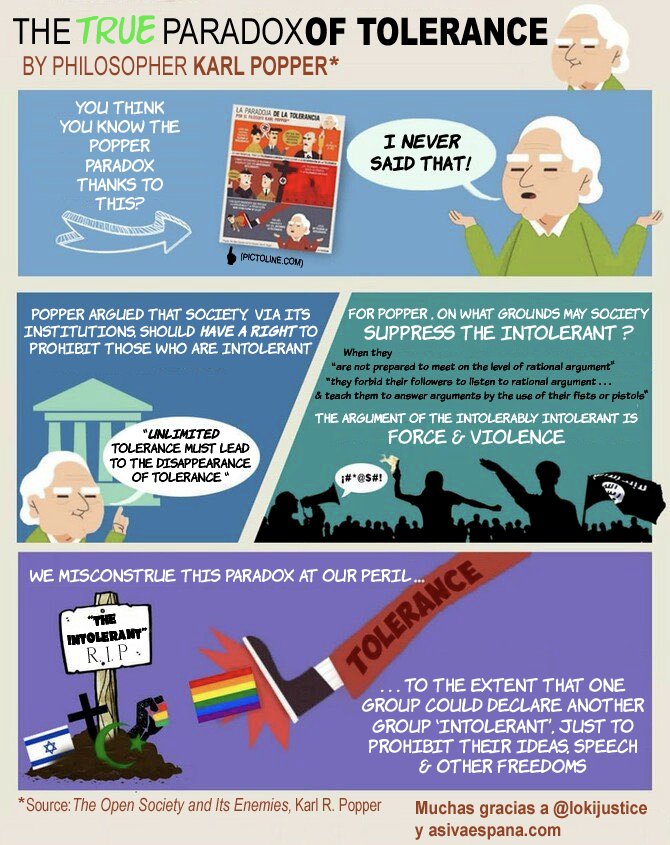
By philosopher Karl Popper[1]
You think you know the Popper Paradox thanks to this? (👉 comic from pictoline.com)
Karl Popper: I never said that!
Popper argued that society via its institutions should have a right to prohibit those who are intolerant.
Karl Popper: Unlimited tolerance must lead to the disappearance of tolerance.
For Popper, on what grounds may society suppress the intolerant? When they “are not prepared to meet on the level of rational argument” “they forbid their followers to listen to rational argument … & teach them to answer arguments by the use of their fists or pistols”. The argument of the intolerably intolerant is force & violence.
We misconstrue this paradox at our peril … to the extent that one group could declare another group ‘intolerant’ just to prohibit their ideas, speech & other freedoms.
Grave sign: “The Intolerant” RIP
Underneath it lies a pile of symbols for Judaism, Christianity, Islam, Black power.
A leg labeled tolerance kicks the Gay Pride symbol into the pile.
Muchas gracias a @lokijustice y asivaespana.com
Karl Popper opposed censorship/argued for free inquiry & open discourse.
I do not imply, for instance, that we should always suppress the utterance of intolerant philosophies; as long as we can counter them by rational argument and keep them in check by public opinion, suppression would certainly be most unwise.
Censorship (or willfully blinding ourselves to information) plays no part in suppressing authoritarianism.
Only cowards fear words. Words are not the danger. It’s the dangerous people whose words we fail to discredit.
Source: The Open Society and Its Enemies, Karl R. Popper ↩︎
Well that’s fucking stupid when we know deplatforming works. Also you’re using specific definitions to deliberately misunderstand the paradox of tolerance so this is a stupid argument in the first place.
Your willful ignorance & stubborn denial of Karl Popper’s directly quoted writing on the subject is not a valid argument. Multiple references cited prove you wrong & you’ve cited nothing. Conventional definitions found here & all over the place (from wikipedia & to SEP) fit Karl Popper’s usage and prove you’re wrong. You’re just wrong.
A fucking high school intellect wrote that garbage article. Also, fuck pacifism, that’s a tool of fascists.
You should be troubled that highschooler can refute you: work on yourself.
And next time use your own words instead of a gpt.
Cool speculative ad hominem: beep boop. Supposing an AI reasons better than you should also trouble you. Try arguing better with logic & evidence next time, genius.
police the platforms
No thanks. The beauty of social media is the unrestrained assholery. People just need to learn to cope & quit being fragile: skill issue. Education & civic campaigns to promote social good are better approaches respecting our inherent liberties to piss people off.
you don’t stop misogyny by just ignoring it you twats, and hot take, mainstream social media
Opinions aren’t stopped. They also don’t need to be. Trying to make individualism a put-down is pathetic.
We all have it in our power to ignore or use our voices to promote our messages with as much force as the messages we oppose. That provocative ragebait engages more effectively than constructive dialog reflects a human failing & a need to work on ourselves.
Social media doesn’t need to be good, and we don’t need to keep using it.
The beauty of social media is we can be totally irredeemable “twats”, victim-blame up the wazoo, and put out the most infuriating shit conceived until we realize it’s all expression lacking substance & none it matters.
It’s only when people start caring too much that we should be concerned for humanity.
They need to get a life or something, stop putting so much of themselves on words, images, & sounds on a screen.
collectively shaming participants
That should suffice. Laws/censorship are unnecessary. Stupid opinions on the internet or in society aren’t new.

Other tech CEOs, including Microsoft’s Bill Gates, Snap’s Evan Spiegel, and Tesla’s Elon Musk, have also spoken about limiting their children’s access to devices. Gates has said he did not give his children smartphones until age 14 and banned phones at the dinner table entirely. Snap CEO Evan Spiegel, in 2018, said he limits his child to the same 1.5 hours per week of screen time as Thiel.
Seems like these failures suing them & demanding government paternalism
Yet, as the trials against social media companies continue and country after country moves toward legislating what Silicon Valley’s billionaires have quietly practiced for years
don’t know how to effectively limit access/use parental controls as tech CEOs claim to do.
If the end user can arbitrarily sign code themselves that is bootable then it kind of defeats the purpose of secure boot.
They can & it doesn’t. They can change the platform key to become the platform owner & control the public keys they keep in the code signing databases. Secure Boot gives the platform owner control over authorized code signers of boot processes.
That’s true today, but there’s no guarantee it will be true in the future.
It’s in the specification.
The platform key establishes a trust relationship between the platform owner and the platform firmware. The platform owner enrolls the public half of the key (PKpub) into the platform firmware. The platform owner can later use the private half of the key (PKpriv) to change platform ownership or to enroll a Key Exchange Key. See “Enrolling The Platform Key” and “Clearing The Platform Key” for more information.
The platform owner clears the public half of the Platform Key (PKpub) by deleting the Platform Key variable using UEFI Runtime Service SetVariable(). The data buffer submitted to the SetVariable() must be signed with the current PKpriv - see Variable Services for details. The name and GUID of the Platform Key variable are specified in Globally Defined Variables. The platform key may also be cleared using a secure platform-specific method. When the platform key is cleared, the global variable SetupMode must also be updated to 1.
It’s a matter of clearing the platform key & enrolling your own platform key. I’ve done this before.
Typically, computers with Secure Boot let us clear the platform key from the boot menu. (You can choose to purchase only those that do.) Some computer vendors ship Secure Boot in setup mode or let the customer provide public keys to ship preloaded.
Secure Boot has always been for enabling the owner to enforce integrity of the boot process through cryptographic signatures. Linus Torvalds thought the feature makes sense.
Linus: I actually think secure boot makes a lot of sense. I think we should sign our modules. I think we should use the technology to do cryptographic signatures to add security; and at the same time inside the open source community this is so unpopular that people haven’t really worked on it.
It’s true that secure boot can be used for horribly, horribly bad things but using that as an argument against its existence at all is I think a bit naive and not necessarily right. Because if you do things right then it’s a really good thing. I would like my own machine to have the option to not boot any kernel, or boot loader, that is not signed by this signature.
Maybe read about the French revolutionary National Assembly & where political left came from?
Yes: crack open a history book.
Liberalism was the original leftism: see the French revolutionary National Assembly. It doesn’t intrinsically have anything to do with capitalism. In general, liberalism is neither left nor right. It promotes individualism. Historically, it progressed from humanism.
leftism begins at anti-capitalism
Not the political science definition.
General definitions & the historical development of liberalism are academic.
liberalism, political doctrine that takes protecting and enhancing the freedom of the individual to be the central problem of politics. Liberals typically believe that government is necessary to protect individuals from being harmed by others, but they also recognize that government itself can pose a threat to liberty.
Some of the earliest liberal practices are found in the US Declaration of Independence, which predates the French revolution spreading the practice of liberal ideals throughout Europe. The US declaration pretty much rehashes core tenets of liberal philosophy
Note how capitalism isn’t mentioned anywhere: it’s nonessential. Capitalism predates & isn’t liberalism. Liberalism is moral & political philosophy, not an economic one.
The philosophy is a natural progression of humanist philosophies from the Renaissance through the Protestant Reformation & the Enlightenment that stress the importance of individuality, secular reasoning, & tolerance over dogma & subservience to unaccountable authority. To address unaccountable authority based on dogma & traditions, English & French philosophers defined legitimate authority based on humanist morality pretty much as expressed in the US declaration. They argued that political systems thrive better with limits & duties on authority & an adversarial system of institutional competition whether in separation of powers, adversarial law system with habeas corpus & right to jury trial, competitive elections, dialogue, or economic competition.
Someone who subscribes to the pretentious “punch down” concept & seems so full of themselves they toss around assumptions of “bigotry”, “racism”, “sexism”, “anti-lgbtq+phobia” on the thinnest of evidence perhaps out of insecurity. Basically, anyone who says things that are a bit sanctimonious & haughty rather than cool & thoughtful possibly because they didn’t get enough hugs growing up or maybe too many.