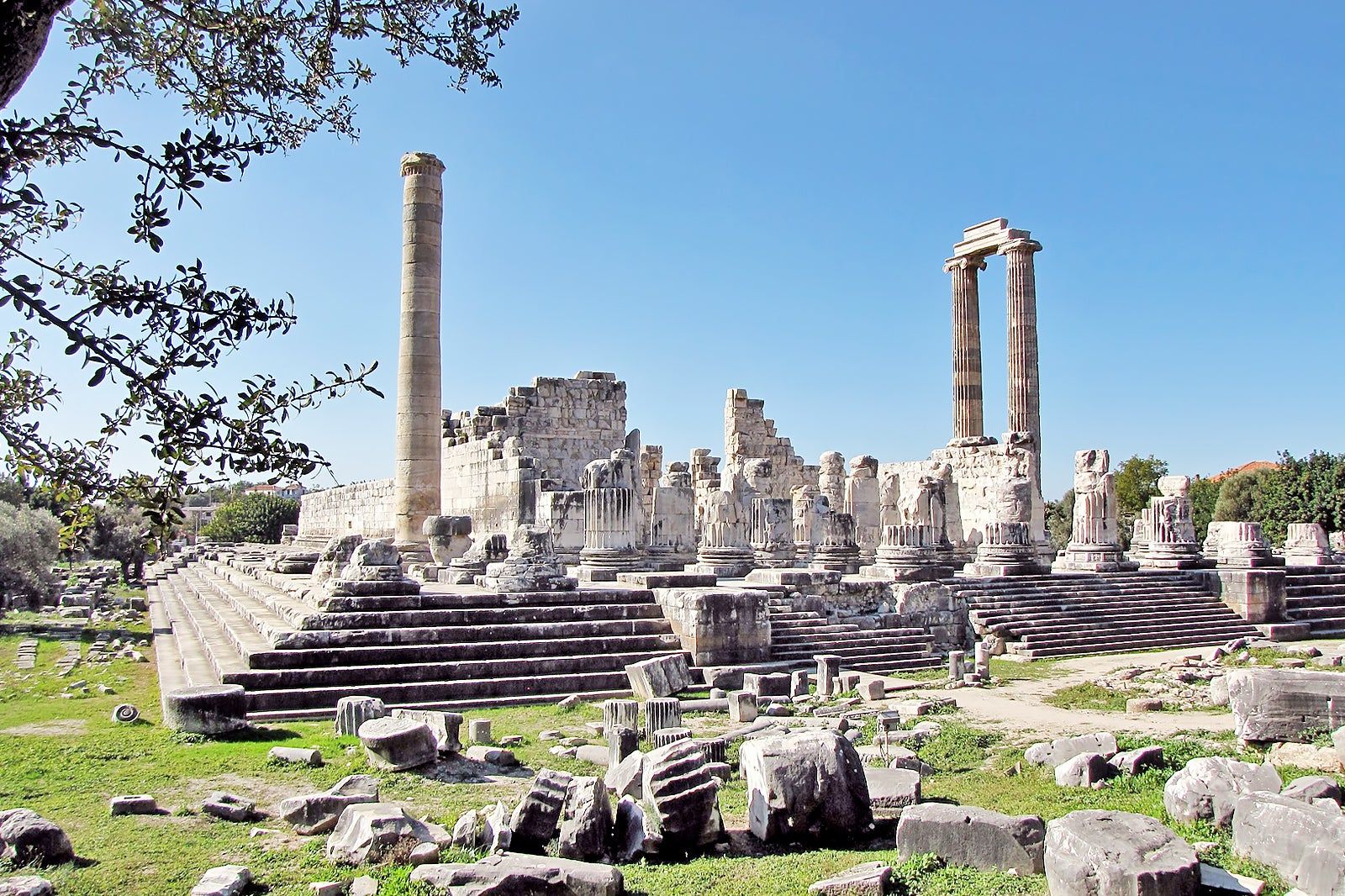
That’s the Temple of Artemis, from an old series I was reading by Jacques Martin:
https://www.bedetheque.com/serie-708-BD-Orion-Martin.html
His many series wade in to ancient and historical peoples, times, and events. Although his handling of plot and character can be pretty outdated and even bumbling, he nevertheless produces consistently interesting visuals, ones which often lead me to asking questions, as above.

https://www.lambiek.net/artists/image/m/martin_jacq/martin_jacques_orion_1990.jpg
I guess I’d just assumed since kid-dom that these temples were made entirely of marble or similar material, hence my puzzlement seeing the image above. Was this just neglect / incompetence by Martin? On the contrary, it seems a lot more technical and correct than I realised. Indeed, a little bit of searching suggests that such roofs were commonly made of wooden rafters, an underlayer sheathing, and then interlocking terracotta tiles.
Something like this, I guess:

https://ars.els-cdn.com/content/image/1-s2.0-S2352409X2300295X-gr10.jpg
With the tiles usually looking like this, perhaps:

https://www.iko.com/na/wp-content/uploads/2026/02/imbrex-tegula-roof-system.webp
I don’t know… maybe some titanically-important temples were attempted in all marble. The Acropolis, perhaps? The problem as I understand it though is that holding up all that weight was incredibly challenging even with an open budget. Or something like that.

@PugJesus@piefed.social,
any comment?Clay tiles, overwhelmingly. Most stone isn’t worth the effort to make into roof tiles; between the weight, expense, and the high rate of replacement (and preference for easy uniformity) needed in roof tiles, only slate is really consistently used for roofing. Other stone, like marble, was occasionally used as a ‘prestige’ project, but clay tiles can be easily and consistently precisely shaped and fitted, allowing for practical concerns like weight distribution and water runoff to be addressed, so it’s generally just not worth it. And marble doesn’t look all that much better in tile form, tbqh.
Maybe if Ancient Greece had balloon-traveling tech, then such prestige-roofs would have made more sense? (hah, but what about the Nazca Lines, Johnny!)
Actually, isn’t that kinda weird… like, every SINGLE item needed to produce air-travel balloons existed in antiquity, and yet it only recently took the MontGolfier Bros to get it done, only recently in history. Seems almost suspicious, somehow…
EDIT: dammit, I forgot about the renewable combustible element in efficient form, necessary.
Many late-coming technologies are issues of concept. Slow-sand filters are incredibly simple, for example, but require an understanding that did not arise until the 19th century (some possible examples in Mesoamerica excepted). Gliders are not actually particularly difficult to acquire the materials or tools to make, especially in cultures that use kites, but require, again, an understanding of the principles involved to provide controlled flight (with gliders requiring precise balance of lift and drag, whereas kites primarily need only light weight and wind stability). Fire pistons are conceptually advanced and were not discovered in Europe until long after they were in Southeast Asia, despite some Southeast Asian cultures which produced and used fire pistons being literal stone-age cultures, in terms of available material tools.
Hot-air balloons, I would imagine, follow the same principle. If you lack the concepts behind the invention, the only way to discover it is by accident, which is generally unlikely. It’s why so much material development is concentrated in the modern and early modern period - we started to piece together how the world, on a fundamental level, works, beyond pure trial-and-error.
Also, hot-air balloons before plastics were often made of silk (and rubber), since most other materials are either too heavy (at least for practical purposes) or too thermally sensitive, and that’s an expensive experiment to be undertaking if you haven’t the first clue how it works.
EDIT: dammit, I forgot about the renewable combustible element in efficient form, necessary.
I mean, early 18th century AD hot-air balloons just used material burned on the ground.
EDIT: I forgot my favorite example! Oral Rehydration Therapy. Understanding how the body is dehydrated and rehydrated allowed doctors in the 19th century, through IV solutions, to drop dysentery (a legitimate killer) mortality rates from ~50% to ~30%. Very advanced, needles and such, understandable why it wasn’t stumbled upon sooner.
… come the 1950s or so, understanding how the body absorbs water led to Oral Rehydration Solution, dropping mortality from ~30% to ~2%.
It can be made with fruit juice, water, and salt. And no additional tools or advanced preparation or specialist administration needed. It’s mixed, and the patient just drinks it - oral rehydration.
Theory isn’t always flashy, but it is often stunning in its successes.
Awesome.
And so much to think about, there. oOIs this okay?
https://lemmy.world/post/49524864Is this okay?
Absolutely!
I did edit to add in my favorite example, if you want to update. I do love the story of dysentery. :p
Oh shit!
That’s right. oOOkay, I’ve added you to the mods list here; edit as you will…?
Sorry mate, we’re bloody-well drowned in toxic fumes these days. Ontario fires.THIS… is not good.
I meant if you wanted to edit the BestOfLemmy post. XD
Sorry mate, we’re bloody-well drowned in toxic fumes these days. Ontario fires.
Damn. Looking at that now.
Disclaimer: Beautifully colorized landscape and architecture drawings with historic themes make me drool!